
Adaptive Operations · Episode 1 · Question 3
How Are Organizations Experiencing Greater Volatility Than They Did a Decade Ago?
Greater volatility is experienced not simply as more change, but as changes occurring across multiple parts of the operating environment, moving more quickly and creating consequences that can develop over shorter periods of time.
Customer demand can shift. Supply chains can be disrupted. Competitors can respond quickly. Economic conditions can alter costs and investment decisions. Cybersecurity threats can develop rapidly. Technologies can emerge before organisations have completed investments in the technologies they are replacing.
At the same time, organisations can see more of these developments than ever before.
Real-time operational data, market information, digital communications, social media, automated monitoring and analytics make developments visible much sooner.
This creates an important Question 3 distinction: are organisations experiencing more volatility, or are they simply seeing more of the volatility that was already there?
The answer can be both.
Greater visibility exposes change sooner, while faster information flows can also allow customers, competitors, markets and other actors to react sooner — creating faster feedback loops throughout the operating environment.
From Question 2 to Question 3
From the Forces of Change to the Experience of Volatility
Question 2 examined some of the forces contributing to declining long-term business stability: technology, economic change, customer expectations, regulation, workforce transformation, environmental pressures and information velocity.
Question 3 asks what the combined effects of a changing environment actually feel like from inside an organisation.
Volatility can appear in different places and in different forms.
For one organisation it may be visible primarily through customer demand. For another it may appear through supply-chain performance, technology, cybersecurity, costs or competitive pressure.
For many organisations, several forms of volatility can occur at the same time.
Experience 1
Market and Customer Volatility
One of the clearest ways organisations can experience volatility is through changes in markets and customer behaviour.
Customer preferences can change more quickly as information, alternatives and new experiences become widely available.
A product or service that previously differentiated an organisation may become expected.
A new competitor can introduce a different experience.
A technological development can alter how customers expect to interact with organisations.
Economic conditions can influence what customers buy, how much they buy and when they buy it.
Volumes and patterns of demand may become more difficult to extrapolate from previous periods.
Customers can rapidly adopt expectations created by new technologies and experiences elsewhere.
Greater visibility of alternatives can make established customer relationships less dependable.
Digital channels allow customer reactions to become visible and spread much faster.
The challenge is not simply that customer behaviour changes.
It is that the period between recognising a change in behaviour and needing to respond to it may become shorter.
Experience 2
Supply Chain Volatility
Modern organisations can depend on extensive networks of suppliers, logistics providers, infrastructure, technologies and specialist services.
Those relationships can create efficiency and access to capabilities that would be difficult or expensive to reproduce internally.
They can also transmit disruption.
A problem affecting a supplier may affect the organisation even when the organisation itself is operating normally.
A logistics disruption can affect material availability.
A technology-service failure can affect multiple business processes.
An environmental event can disrupt infrastructure or transportation elsewhere in the network.
An organisation's operational exposure extends beyond the assets and activities it directly controls.
Volatility elsewhere in the dependency network can become volatility inside the organisation.
This makes understanding dependencies increasingly important.
Leadership needs to know not only who the organisation depends upon, but what critical operations depend upon them and what alternatives exist if those dependencies become unavailable.
Experience 3
Accelerating Competitive Pressure
Competitive change can also occur faster.
Technology can reduce barriers to entry. Digital platforms can make it easier to reach customers. New business models can change how value is created and delivered.
Established competitors can introduce new capabilities quickly.
Organisations that were previously outside an industry can enter parts of its value chain.
Competition may therefore emerge from directions that were not previously considered strategically significant.
This can shorten the time available to recognise a competitive development, determine its significance and respond.
The organisation may still have a clear long-term strategy, but the assumptions about how that strategy should be executed may require more frequent reconsideration.
Experience 4
Economic Volatility
Economic conditions influence many of the assumptions organisations use when making decisions.
Inflation can alter operating costs.
Interest rates can affect financing and investment.
Currency movements can change the economics of international sourcing and sales.
Energy prices can affect production, logistics and infrastructure.
Changes in consumer or business confidence can alter demand.
Labour-market conditions can affect both cost and access to skills.
The issue is not that economic forecasting becomes useless.
It is that organisations may need to understand how sensitive their plans are to different economic conditions and recognise when the assumptions supporting those plans are moving outside the range originally expected.
Experience 5
Cybersecurity as Operational Volatility
Cybersecurity demonstrates particularly clearly how the operating environment can evolve continuously.
Threats change.
Vulnerabilities are discovered.
Attack techniques evolve.
Technologies and systems change.
Suppliers and third-party services create additional points of dependency.
An organisation can therefore move from one risk position to another without making a deliberate strategic decision to do so.
A control environment that was appropriate yesterday does not automatically remain appropriate when the technology, threat or dependency environment changes.
Cybersecurity also illustrates how a rapidly changing external condition can become an immediate operational issue.
A development outside the organisation can quickly require internal investigation, decisions, controls and potentially operational action.
Experience 6
Technology and Investment Uncertainty
Technology creates another form of volatility because major technology investments often have long implementation and useful lives while the surrounding technology environment continues to develop.
An organisation may spend several years selecting, implementing and embedding a platform.
During that time, new technologies can emerge.
Capabilities that once required major bespoke development may become widely available.
Architectural assumptions can change.
Customer and employee expectations can change because of technologies adopted elsewhere.
This does not mean organisations should continually replace technology.
It means that major investments may need to be designed and governed with the possibility of future change in mind.
Multiple Forms of Acceleration
Volatility Can Occur Across Several Dimensions at Once
The organisational challenge becomes more difficult when different forms of volatility occur simultaneously.
Customer behaviour may be changing while technology is changing.
Technology may be changing while regulation is changing.
Regulation may be changing while the organisation is experiencing workforce constraints.
All of this may happen while economic conditions alter the cost of responding.
Demand, customer behaviour and competitive conditions can move.
Suppliers, logistics and critical dependencies can become less predictable.
New capabilities and new risks can emerge during existing investment cycles.
Costs, financing, currencies and investment conditions can alter organisational assumptions.
Threats and vulnerabilities can change faster than traditional planning cycles.
Developments become visible more quickly and reactions can propagate faster.
This is one reason volatility cannot always be managed effectively through separate functional views.
Leadership may need to understand how several changing conditions combine around the same strategic objective, operation or decision.
A Critical Distinction
Greater Volatility or Greater Visibility?
Organisations now have access to information that previous generations of leaders could not obtain as quickly or as easily.
Operational dashboards can update continuously.
Market information can be available almost immediately.
Customer sentiment can become visible through digital channels.
Supply-chain events can be tracked.
News from around the world can reach decision-makers within minutes.
It is therefore reasonable to ask whether the world has become more volatile or whether organisations have simply become better at observing volatility.
These explanations are not mutually exclusive.
Greater visibility can itself contribute to greater volatility because other actors also have access to faster information.
Faster Feedback Loops
Information Does Not Just Describe the Environment — It Can Change It
When information moves faster, people and organisations can respond faster.
Customers see something and react.
Competitors observe that reaction and respond.
Markets interpret the response.
Media and social channels amplify the development.
Leadership teams respond to the new information generated by those reactions.
The result can be a feedback loop in which information and behaviour continuously influence one another.
Faster information can compress the time between an external development and its organisational consequences.
This is important because many traditional decision processes were designed for environments in which leadership had more time between observing a development and needing to respond.
Decision Velocity
The Decision Window Can Become Shorter
Volatility matters because it can change the amount of time available to make an effective decision.
Consider a development that historically took twelve months to produce a meaningful organisational effect.
A quarterly reporting cycle might have provided sufficient time to identify it, investigate it and respond.
If a similar development can now produce material effects within a few weeks, the same reporting and governance process may no longer provide leadership with enough time.
This does not mean every decision should be accelerated.
Some decisions benefit from deliberate analysis and should remain slow.
The important capability is being able to distinguish between decisions where time is available and decisions where delay itself increases exposure.
Inside the Organisation
Volatility May Be Visible at the Frontline Before It Reaches Leadership
The first signs of changing conditions may not appear in executive reports.
Sales teams may notice changing customer questions.
Procurement teams may see suppliers becoming less dependable.
Operations teams may see recurring exceptions.
Technology teams may see changing usage patterns.
Risk teams may see emerging exposures.
Customer-service teams may see new categories of complaint.
Individually, these signals may appear small.
Together, they may indicate that an assumption about the operating environment is beginning to change.
The challenge is not simply collecting more information. It is ensuring that potentially important signals can be connected, interpreted and escalated.
Signal Versus Noise
Not Every Fluctuation Represents a Structural Change
Greater visibility creates a danger of its own.
If organisations can see more change, they can also become tempted to react to more change.
But volatility is not automatically evidence that strategy should change.
A temporary movement in demand may reverse.
A short-term supply disruption may be resolved.
A technology may attract attention without becoming strategically important.
A market reaction may be temporary rather than structural.
Adaptive organisations therefore need both sensitivity and discipline.
They need to recognise potentially important change without becoming strategically reactive to every fluctuation.
Key Takeaways
How Is Greater Volatility Changing the Organisational Experience?
Question 3 moves beyond identifying the forces of change and considers what their effects look like from inside the organisation.
- Market and customer behaviour can change more quickly.
- Disruption can propagate through suppliers, technologies, infrastructure and other dependencies.
- Competitive pressure can emerge from new technologies, capabilities and business models.
- Economic movements can alter several assumptions within the same business case simultaneously.
- Cybersecurity demonstrates how external conditions can evolve continuously and create immediate operational consequences.
- Long-term technology investments must operate within a technology environment that continues changing during their implementation.
- Several forms of volatility can affect an organisation at the same time.
- Organisations have greater visibility of change, but that visibility can also contribute to faster reactions and feedback loops.
- The time between recognising a development and needing to respond can become shorter.
- Not every fluctuation requires action. Organisations need to distinguish temporary variation from material change.
Executive Reflection
Questions for Leaders to Consider
Where Is Volatility Appearing?
- Which parts of your operating environment have become less predictable during the last decade?
- Is volatility most visible through customers, suppliers, technology, competition, economics or another area?
- Are several forms of volatility interacting?
How Quickly Is Change Becoming Visible?
- Where does the earliest evidence of changing conditions appear?
- Who sees that evidence first?
- How long does it take before leadership becomes aware of it?
How Quickly Can You Decide?
- How long does the organisation take to determine whether an emerging development matters?
- Which governance or approval processes affect the speed of response?
- Are there circumstances where the decision cycle is slower than the environment being managed?
Can You Distinguish Signal from Noise?
- How does the organisation distinguish temporary fluctuation from structural change?
- What evidence would justify reconsidering an existing assumption?
- Could greater access to real-time information cause the organisation to become too reactive?
The Episode 1 Journey
Where Does Question 3 Lead Next?
Question 1 established what declining operating-environment stability means.
Question 2 examined some of the forces contributing to that decline.
Question 3 has examined how organisations can experience the result through greater volatility, faster information flows and shorter decision windows.
That leads to the next question.
Question 4 examines the relationship between historical patterns, forecasting, long-term plans and the assumptions that connect past experience to future expectations.
Continue Exploring
Explore the Episode 1 Question Banks
The five Question Banks build progressively from understanding declining operating-environment stability to the implications for organisational planning and leadership.
Episode 1 · Full Discussion
Explore the Complete Episode
The End of Stable Operating Environments brings all five Question Banks together into the complete Episode 1 discussion.
Explore how declining stability, interacting external forces, greater volatility, changing planning assumptions and organisational risk combine to create a new challenge for leadership.
Continue the Episode 1 (Part 1) Journey
From Operational Uncertainty to Enterprise Resilience
The five Episode 1 questions explore why stable operating assumptions are becoming less dependable and what that means for leadership.
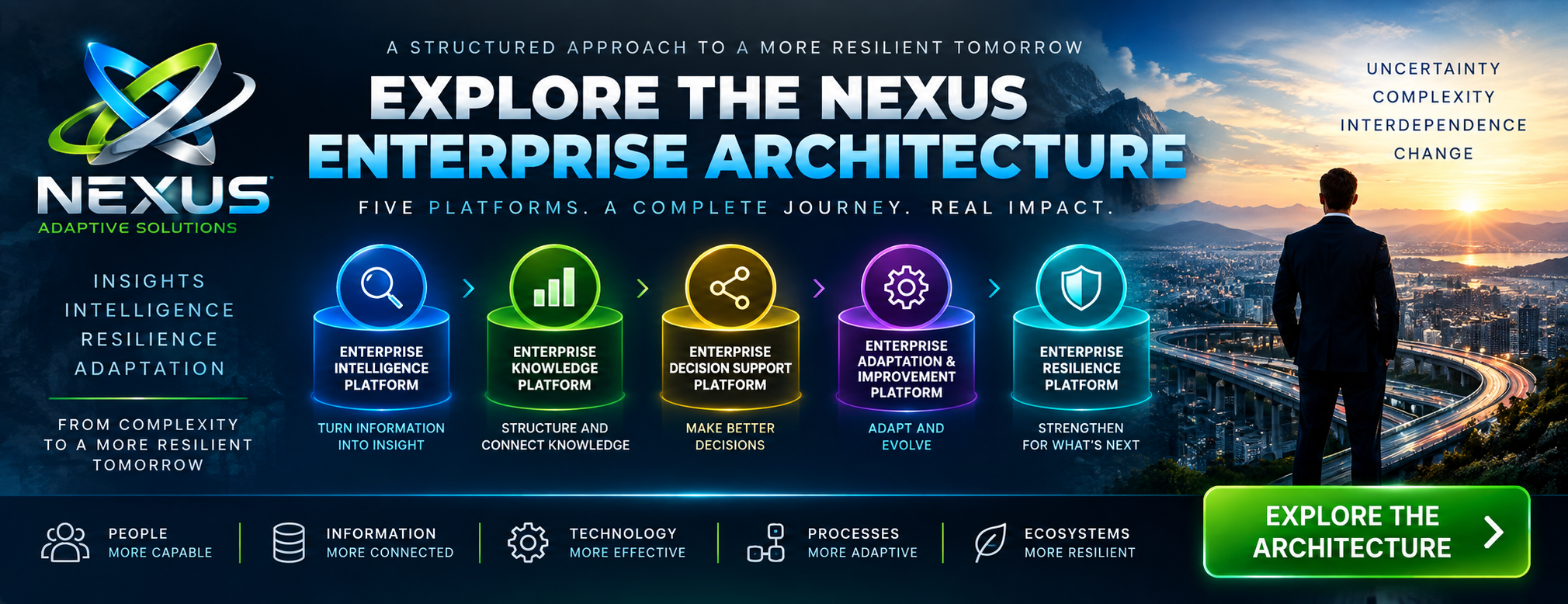
The next stage explores how organisations can respond through an integrated Enterprise Capability Architecture — connecting operational awareness, intelligence, decision support, adaptation and enterprise knowledge.
Explore the Enterprise Capability Architecture →Nexus Adaptive Solutions
How Does Volatility Affect Your Organisation?
Volatility becomes strategically important when it is connected to the organisation's actual objectives, operations, investments, capabilities and dependencies.
The important questions are therefore not simply whether the environment is volatile, but where that volatility creates exposure, how quickly its effects could develop and whether leadership can recognise and respond to those effects in time.
The Intelligence Discovery Session provides a structured way to explore the challenges affecting your organisation, the decisions leadership needs to make and the capabilities that may be required.
The Enterprise Capability & Maturity Assessment provides a deeper evidence-based examination of existing enterprise capabilities, gaps and future requirements.