
Adaptive Operations · Episode 1 · Question 4
Why Are Traditional Planning Assumptions Becoming Less Reliable?
Organisations need plans. They need forecasts, budgets, investment cases, strategic priorities and expectations about what the future may look like. The challenge is not that planning has become unnecessary. It is that some of the assumptions connecting past experience to future expectations may remain dependable for shorter periods of time.
Traditional planning frequently uses historical information to identify patterns and project those patterns forward.
That remains useful.
But historical data describes what happened under a particular set of conditions. If those conditions change, the historical pattern can remain completely accurate while becoming less reliable as a guide to what happens next.
The problem is not necessarily with the historical data.
The problem may be with the assumption that the conditions that produced the historical pattern will continue into the future.
From Question 3 to Question 4
What Does Greater Volatility Mean for Planning?
Question 3 examined how organisations can experience greater volatility through customers, markets, supply chains, competition, economics, cybersecurity, technology and faster information flows.
It also introduced an important timing issue.
The period between recognising a material change and needing to respond to it can become shorter.
That creates a direct challenge for planning.
A plan may have been developed using entirely reasonable assumptions about demand, costs, technology, regulation, workforce availability, suppliers and competitive conditions.
But what happens when those assumptions change while the plan is still being executed?
Historical Patterns
Historical Data Can Be Accurate Without Predicting the Future
Historical information is one of the most important resources available to organisational decision-makers.
It can show how demand has behaved, how customers have responded, how costs have moved, how operations have performed and how previous decisions have worked.
Organisations can use those observations to identify patterns.
Those patterns can then inform forecasts.
The difficulty appears when a historical relationship depends on conditions that are themselves changing.
Imagine that demand for a service has grown consistently for several years.
The historical evidence is real.
But the continuation of that growth may depend on customer preferences, pricing, competition, regulation, technology and economic conditions remaining sufficiently similar.
If one or more of those conditions changes materially, the historical pattern may no longer provide the same insight into future demand.
Forecasting
The Challenge of Long-Term Forecasting
Forecasting necessarily involves uncertainty.
No organisation expects a five-year forecast to predict every future event precisely.
The forecast instead provides a structured view of what the future might look like based on the information, assumptions and models available today.
The challenge is that uncertainty can increase as the forecast extends further into the future.
Will customers continue behaving in ways consistent with previous patterns?
Will today's technologies and technical assumptions remain appropriate?
Will costs, financing conditions and demand remain within the ranges assumed?
Will the competitive environment develop in the way the strategy expects?
Will the regulatory environment remain sufficiently consistent with the current plan?
Will the organisation be able to access the skills and capabilities the plan requires?
The further the organisation projects forward, the more opportunity there is for one or more of these conditions to change.
Long-term forecasting therefore becomes not simply an exercise in projecting a central expectation, but in understanding the assumptions on which that expectation depends.
Plans and Assumptions
A Plan Can Remain on Track While Its Assumptions Change
This creates one of the most important distinctions in Question 4.
Organisations are often very good at monitoring execution.
Projects have milestones.
Programmes have budgets.
Transformation initiatives have governance structures.
Performance is tracked against agreed targets.
Leadership can therefore know whether the organisation is delivering what it planned to deliver.
But that is not quite the same as knowing whether the assumptions that made the plan sensible still hold.
Both questions matter.
A programme can be on time, on budget and delivering its agreed outputs while the environment around the original business case is changing.
Execution performance tells leadership whether the organisation is delivering the plan.
It does not, by itself, tell leadership whether the plan remains aligned with the environment.
A Simple Example
What Happens When the Plan Remains the Same but the Environment Does Not?
Consider an organisation beginning a major multi-year transformation programme.
At the point of approval, the business case may depend on assumptions about customer demand, technology, costs, workforce availability and regulatory requirements.
The programme begins.
Eighteen months later, implementation may be progressing exactly as planned.
But perhaps a new technology has emerged.
Customer expectations have changed.
A regulatory development has introduced new requirements.
Specialist skills have become more difficult to obtain.
None of this necessarily means that the programme should stop.
But it does mean that leadership has new information that may affect the assumptions supporting the original decision.
The important capability is therefore not simply planning well at the beginning.
It is maintaining a relationship between the plan and the changing environment throughout execution.
Adaptive Planning
From Fixed Plans to Plans That Can Adapt
A fixed plan can work extremely well when the conditions supporting it remain sufficiently stable.
Leadership establishes an objective, defines the route, allocates resources and manages execution.
The problem arises when the route is treated as though it has the same permanence as the objective.
Those two things do not necessarily need to change together.
An organisation can maintain a consistent strategic objective while changing the route used to reach it.
That distinction becomes important in more volatile environments.
The objective may remain entirely valid while the assumptions supporting a particular implementation approach change.
Adaptive planning does not mean abandoning long-term direction.
It means retaining the ability to adjust the route when evidence shows that the assumptions supporting the existing route have materially changed.
Linear Forecasting
The Limits of Extending Existing Trends Forward
One common planning technique is to identify an existing trend and extend it into the future.
If demand has grown consistently, future demand may be projected using that pattern.
If costs have moved within a relatively stable range, future costs may be estimated using that history.
If a market has developed steadily, the organisation may expect continued development along a similar trajectory.
This can be entirely reasonable when the underlying system remains relatively stable.
But the projection becomes less dependable when the conditions generating the trend begin to change.
This is why organisations need to understand more than the trend itself.
They need to understand the important factors and relationships behind it.
Assumption Visibility
Important Assumptions Need to Be Visible
Organisations cannot monitor assumptions that have never been made explicit.
Some assumptions are documented in business cases, risk registers, forecasts or strategy documents.
Others may remain implicit.
A plan may assume that customer behaviour will remain broadly consistent without explicitly saying so.
An investment may assume continued access to specialist skills.
A technology programme may assume that a particular architecture remains appropriate.
A supply strategy may assume that certain dependencies remain dependable.
Making important assumptions visible creates the possibility of monitoring them.
State clearly what the plan expects to remain true.
Identify which decision, objective or investment depends upon it.
Identify the evidence currently supporting the assumption.
Identify developments that could weaken or invalidate it.
Identify the evidence that would indicate conditions are changing.
Understand when changed evidence should trigger review or action.
Scenario Planning
Why Scenario Planning Becomes More Valuable
When the future becomes less dependable, organisations do not need to stop planning.
They may need to plan across a wider range of plausible conditions.
Scenario planning provides one way of doing that.
Instead of asking only:
leadership can also ask:
How would the plan perform under a different demand pattern?
Which parts of the business case become sensitive?
Would today's planned capability remain appropriate?
What additional obligations or investments could emerge?
How would operations continue and what alternatives exist?
Could their combined effect alter the preferred decision?
The purpose is not to predict which scenario will occur perfectly.
It is to understand how decisions behave under different plausible conditions and where the organisation may need flexibility.
Decision Triggers
Plans Can Include Conditions for Reconsideration
If an organisation knows which assumptions matter, it can also identify evidence that would justify reviewing them.
These do not need to be automatic instructions to change direction.
They can simply act as triggers for leadership attention.
For example, a strategy may depend on a particular range of customer demand.
If demand moves materially outside that range for a sustained period, leadership may review the underlying assumption.
A technology programme may depend on a particular technical architecture remaining appropriate.
The emergence of a materially different capability could trigger a review before the next major investment stage.
The trigger does not make the decision.
It ensures that changed conditions become visible to the people responsible for deciding whether the existing plan remains appropriate.
Strategic Discipline
Adaptability Is Not Indecision
Adaptive planning can be misunderstood as constantly reconsidering every decision.
That would create its own problems.
Organisations need commitment.
Major programmes need time to deliver.
Investments need continuity.
Employees need clear priorities.
Strategies cannot be rewritten every time new information appears.
The objective is therefore not continuous change.
It is disciplined reconsideration when the evidence warrants it.
This allows organisations to combine execution discipline with the ability to adapt.
Direction and Route
Strategic Direction Can Remain Stable While the Route Changes
One of the most useful distinctions for adaptive planning is the difference between strategic direction and the assumptions supporting the current route.
An organisation may have a long-term objective to improve customer service, strengthen resilience, increase operational efficiency, expand capacity or develop a new capability.
That objective may remain entirely appropriate.
But the preferred way of achieving it can change as new information becomes available.
This distinction allows organisations to avoid two extremes.
They do not need to remain rigidly committed to an outdated route.
And they do not need to abandon long-term strategic direction every time conditions change.
Governance
Planning Assumptions Need Owners, Not Just Documents
An assumption can be documented without being actively managed.
If an important assumption changes, someone needs to recognise that change, understand its significance and bring it into the relevant decision process.
This raises practical governance questions.
- Who owns the assumption?
- Who monitors the evidence related to it?
- How frequently should it be reviewed?
- What evidence would trigger an earlier review?
- Who determines whether the change is material?
- Which decision-maker needs to know?
- What authority exists to adapt the plan?
Without those mechanisms, organisations can identify changing conditions but still struggle to translate that information into changed decisions.
Key Takeaways
Why Are Planning Assumptions Becoming Less Reliable?
Question 4 does not suggest that forecasting, historical analysis or long-term planning should be abandoned.
It highlights the need to understand the assumptions that allow those tools to remain useful.
- Historical data can remain accurate even when the conditions that created the historical pattern have changed.
- Forecasts depend not only on data but on assumptions about how current relationships will continue.
- Uncertainty generally increases as planning extends further into the future.
- A programme can remain on time and on budget while the assumptions supporting its original business case change.
- Execution performance and continued strategic relevance are different questions.
- Important assumptions need to be visible before they can be monitored.
- Scenario planning can help leadership understand how decisions perform under different plausible conditions.
- Indicators and triggers can identify when an important assumption warrants reconsideration.
- Adaptability does not require constant changes of direction.
- Strategic direction can remain consistent while the route used to achieve it changes.
Executive Reflection
Questions for Leaders to Consider
Your Planning Assumptions
- What are the most important assumptions underpinning your current strategy?
- Which assumptions underpin your major investment and transformation programmes?
- Are those assumptions explicitly documented?
- Which would have the greatest impact if they changed?
Your Historical Evidence
- Which important forecasts rely heavily on historical patterns?
- What conditions created those patterns?
- Are those conditions still present?
Your Governance
- Who is responsible for monitoring important planning assumptions?
- What evidence would trigger a review?
- Can assumptions be challenged outside the normal annual planning cycle?
- Who has authority to adapt a plan when the evidence changes?
Your Ability to Adapt
- Could a major programme continue successfully executing after its underlying assumptions had changed?
- How would leadership know?
- Which commitments are difficult to reverse once made?
- Where could greater flexibility be designed into future decisions?
The Episode 1 Journey
Where Does Question 4 Lead Next?
Question 1 established what declining operating-environment stability means.
Question 2 examined some of the forces contributing to that decline.
Question 3 considered how organisations experience greater volatility.
Question 4 has now examined what that means for forecasting, assumptions and long-term planning.
That leads to the final question in the Episode 1 Question Bank.
Question 5 examines what can happen when the organisation continues executing successfully while the assumptions connecting its strategy to the external environment progressively weaken.
Continue Exploring
Explore the Episode 1 Question Banks
The five Question Banks progressively connect environmental change to the assumptions, decisions and risks facing organisational leadership.
Episode 1 · Full Discussion
Explore the Complete Episode
The End of Stable Operating Environments brings all five Question Banks together into the complete Episode 1 discussion.
Explore the progression from declining environmental stability and greater volatility through changing planning assumptions to the implications for leadership, decision-making and organisational adaptation.
Continue the Episode 1 (Part 1) Journey
From Operational Uncertainty to Enterprise Resilience
The five Episode 1 questions explore why stable operating assumptions are becoming less dependable and what that means for leadership.
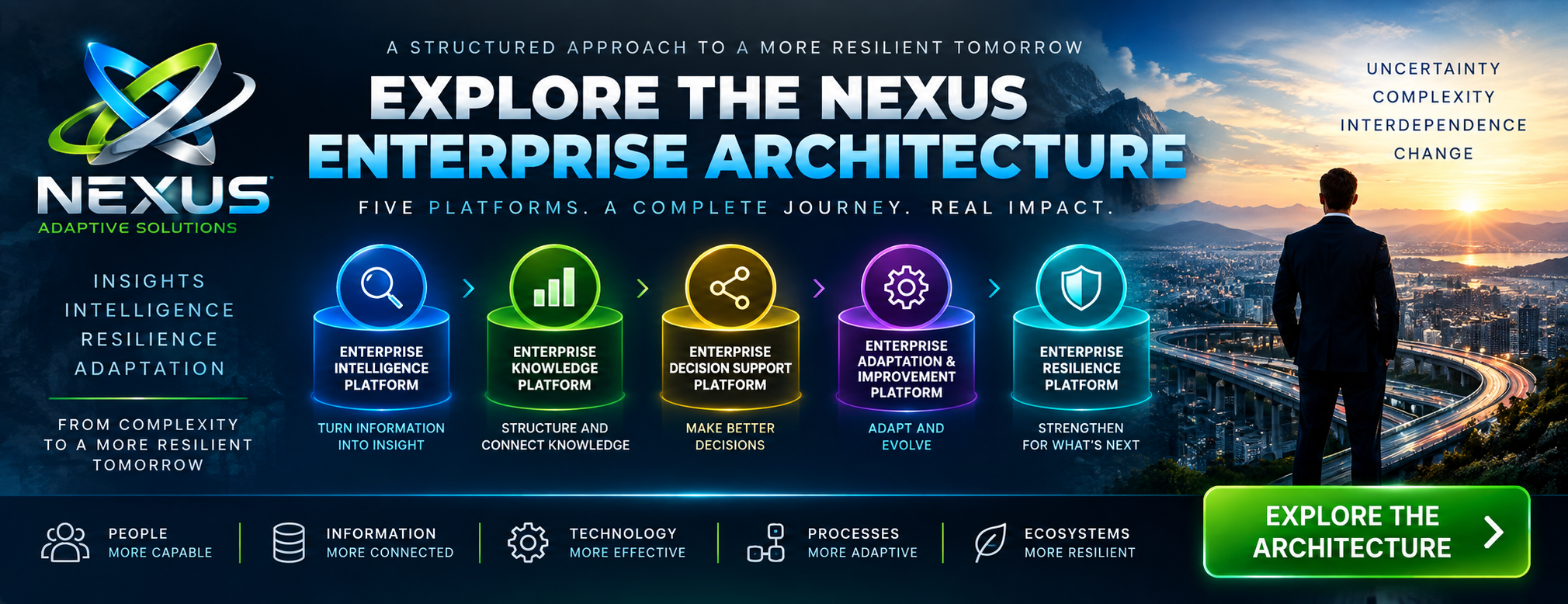
The next stage explores how organisations can respond through an integrated Enterprise Capability Architecture — connecting operational awareness, intelligence, decision support, adaptation and enterprise knowledge.
Explore the Enterprise Capability Architecture →Nexus Adaptive Solutions
Which Assumptions Does Your Organisation Depend On?
Every strategy, investment and transformation programme depends on assumptions about the environment in which it will be executed.
The challenge is understanding which assumptions matter most, identifying the evidence that supports them and recognising when changing conditions mean that they should be reconsidered.
The Intelligence Discovery Session provides a structured way to explore the challenges affecting your organisation, the decisions leadership needs to make and the capabilities that may be required.
The Enterprise Capability & Maturity Assessment provides a deeper evidence-based examination of existing enterprise capabilities, gaps and future requirements.