
Adaptive Operations · Episode 1 · Question 2
What Forces Have Contributed to the Decline of Long-Term Business Stability?
The decline of long-term business stability cannot be explained by one technology, one economic development or one disruptive event. Organisations are operating within environments shaped by multiple forces that can change independently, interact with one another and reinforce each other's effects.
Technology is accelerating. Economic conditions can change rapidly. Customer expectations continue to evolve. Regulatory requirements are expanding. Workforce expectations and skills requirements are changing. Environmental pressures can affect operations and supply chains. Information moves around the world almost instantaneously.
None of these forces is entirely new.
What is significant is the combination of their speed, reach, interaction and simultaneity.
Organisations are not simply dealing with more change.
They increasingly need to understand how multiple forms of change can combine to alter the conditions on which strategies, investments and operations depend.
From Question 1 to Question 2
From Understanding Stability to Understanding What Is Changing It
Question 1 established an important distinction.
A stable operating environment does not mean that nothing changes. It means that enough of the conditions surrounding an organisation remain sufficiently predictable for established assumptions to continue providing a useful basis for decisions.
That leads naturally to Question 2.
If organisations are finding it more difficult to assume that those conditions will remain dependable for long periods, what is causing that change?
There is no single answer.
Different industries, organisations and geographies will experience different combinations of pressures. A technology company may be affected particularly strongly by technological acceleration. An infrastructure operator may be highly exposed to regulation, workforce availability and environmental conditions. A manufacturer may experience the effects through customers, energy, technology, skills and global supply relationships.
Force 1
Technology Is Accelerating
Technological change has always influenced organisations, but the pace at which new technologies can emerge, mature and spread creates a particular challenge for long-term assumptions.
Artificial intelligence, automation, cloud computing, advanced analytics, digital platforms and increasingly connected systems can change what organisations are capable of doing.
They can also change what competitors are capable of doing.
A technology may reduce the cost of an activity, automate work that previously required significant human effort, create a new service, enable a different business model or make previously unavailable information accessible.
The difficulty for leadership is that investment decisions often need to be made before the eventual effect of a technology is fully understood.
Moving early may create capability or competitive advantage, but the technology may still be immature.
Waiting can reduce technical uncertainty, but competitors may develop capability first.
New technology may require skills, data, infrastructure and governance that the organisation does not yet possess.
The value of a technology may depend on changing processes, responsibilities and ways of working around it.
Technology therefore creates both opportunity and uncertainty.
It can change not only the tools an organisation uses, but the assumptions on which existing investments, capabilities and strategies were based.
Force 2
Globalisation and Global Economic Change
Organisations increasingly operate within interconnected economic systems.
Even organisations whose customers are primarily domestic may rely on technologies, materials, energy, financing, suppliers or services connected to international markets.
This means that developments far beyond the organisation's immediate market can influence its operating conditions.
Interest rates can affect investment decisions and customer demand. Inflation can alter costs. Currency movements can change the economics of international sourcing. Energy prices can affect production, logistics and infrastructure. Changes in investment conditions can influence access to capital.
Labour-market conditions can affect both cost and the availability of critical skills.
Geographic distance does not necessarily mean operational distance.
A development elsewhere in the economic system can propagate through suppliers, customers, energy, finance, logistics or investment and eventually affect the organisation.
The strategic challenge is therefore not simply understanding the organisation's immediate market.
Leadership increasingly needs to understand the wider economic relationships on which the organisation depends.
Force 3
Changing Customer Expectations
Customer expectations do not develop only within individual industries.
People experience services across many parts of their lives, and those experiences influence what they expect elsewhere.
A customer who becomes accustomed to immediate digital access in one context may begin to expect similar convenience in another.
Fast delivery can become normal.
Real-time information can become expected.
Digital self-service can move from being a differentiator to a basic requirement.
Personalisation can move from exceptional to commonplace.
This can shorten the period over which established propositions, service models and customer experiences remain differentiated.
Organisations may therefore need to monitor not only direct competitors but broader changes in customer behaviour and expectations.
Force 4
Increasing Regulatory Demands
Regulation is sometimes treated primarily as a compliance concern. But regulatory change can have much wider organisational effects.
Requirements relating to data, cybersecurity, artificial intelligence, financial transparency, employment, sustainability and environmental responsibility can influence how an organisation operates.
A regulatory development may require new controls.
Those controls may require new technology.
New technology may require additional data or skills.
New responsibilities may require changes to governance, processes and organisational roles.
Regulation can therefore influence strategy, investment and operating-model decisions rather than sitting outside them as a separate compliance activity.
For organisations operating across several jurisdictions, this can become even more complex because the regulatory environment itself may vary by market.
Force 5
Workforce Transformation
An organisation's ability to execute its strategy ultimately depends on people and capabilities.
Workforce conditions can therefore become an important source of environmental change.
Organisations may face shortages in specialist skills while simultaneously experiencing changing expectations around flexibility, career development, learning, wellbeing, purpose and ways of working.
Technology can also alter the skills an organisation requires.
Some activities may become automated. Existing roles may change. New roles may emerge. Employees may need to work with systems and information that did not previously exist.
Workforce change is therefore not simply an HR consideration.
It can determine whether an otherwise sound strategy is executable.
Force 6
Environmental and Climate-Related Pressures
Environmental conditions can influence organisations directly and indirectly.
Extreme weather, flooding, heat and water availability can affect physical operations, infrastructure, transport, logistics and employees.
But the organisation does not need to experience an environmental event directly for it to be affected.
A supplier may be disrupted.
A transport route may become unavailable.
Energy availability or cost may change.
Insurance conditions may alter.
Infrastructure elsewhere in the organisation's dependency network may be affected.
Environmental exposure can exist beyond the organisation's own physical boundaries.
Understanding the organisation's dependencies therefore becomes important when assessing how environmental change could affect operations.
Force 7
Information Velocity
One of the most significant changes in the modern operating environment is the speed at which information moves.
News travels quickly.
Customers can react quickly.
Markets can react quickly.
Employees can react quickly.
Competitors can react quickly.
Investors can react quickly.
Social media and digital communication can amplify developments before organisations have fully understood what has happened.
This creates an unusual challenge.
Organisations have access to more information than ever before, but the time available to interpret that information may be becoming shorter.
The challenge is therefore not simply acquiring information.
It is converting information into useful intelligence quickly enough to support decisions.
The Combined Effect
Why Is Today's Operating Environment Different?
Technology is not new.
Economic change is not new.
Customers changing their expectations is not new.
Regulation, workforce change and environmental disruption are not new either.
The distinction lies increasingly in the way these forces can move together.
A technological development can change customer expectations.
That change can alter competitive behaviour.
Competitors may introduce new technology-enabled services.
Regulators may then respond to new practices or risks.
The organisation may need new skills to comply and compete.
All of this may happen while economic conditions affect the capital available to fund the required changes.
The challenge is increasingly systemic rather than isolated.
Organisations may need to understand not only individual forces, but the relationships between them.
Interconnected Change
One Force Can Amplify Another
The combined effect of environmental forces can be greater than the effect of each force considered independently.
New technology can enable experiences that alter what customers expect from every organisation.
New technological capabilities can create new regulatory, governance and risk requirements.
Technology adoption can create demand for skills that are already difficult to obtain.
Changing economic conditions can affect the organisation's ability to fund adaptation precisely when investment is required.
Environmental events can affect suppliers, logistics, infrastructure and availability simultaneously.
Faster information can accelerate reactions to technological, economic, regulatory and competitive developments.
This is why simply creating separate reports for technology, regulation, markets, workforce and risk may not always provide leadership with a complete picture.
The significance can lie in the relationships between them.
Leadership Capacity
The Cumulative Leadership Challenge
As the number of relevant developments increases, leadership faces a capacity problem.
The organisation still needs to operate.
Customers still need to be served. Employees need direction. Projects need decisions. Budgets need to be managed. Risks need to be controlled and regulatory obligations need to be met.
At the same time, leadership needs to understand what is changing outside the organisation.
More information does not automatically create better decisions.
Without mechanisms for filtering, connecting and interpreting information, it can simply create more noise.
One of the emerging organisational challenges is therefore ensuring that the number and speed of changes requiring interpretation do not exceed the organisation's ability to understand their significance.
Signal and Noise
Not Every External Development Requires a Response
A more dynamic operating environment does not mean that organisations should react to everything.
That would create instability of its own.
Thousands of technological, economic, regulatory and competitive developments may occur without having any material effect on a particular organisation.
The objective is therefore not simply to monitor more.
It is to determine what is relevant.
A development becomes important when it has a meaningful relationship to something the organisation cares about: a strategic objective, operation, customer, asset, capability, supplier, technology, investment or dependency.
Organisational Implication
Environmental Awareness Needs Organisational Context
Knowing that an external development has occurred is only the first step.
Leadership also needs to understand how that development relates to the organisation.
A regulatory proposal may be significant for one business unit and irrelevant to another.
A new technology may affect a critical capability but have little relevance elsewhere.
An environmental event may occur thousands of kilometres away but affect a supplier on which a critical service depends.
An economic development may affect a customer segment before it has any direct impact on the organisation itself.
External knowledge therefore becomes more useful when it can be connected to internal organisational context.
The important question is not simply “What is happening?” but “What does what is happening mean for us?”
Key Takeaways
What Is Driving the Decline of Long-Term Business Stability?
Question 2 does not identify one dominant cause.
Instead, it highlights an operating environment shaped by multiple interacting forces.
- Technology can alter capabilities, business models, competition and customer expectations.
- Global economic developments can propagate through finance, energy, demand, labour and supply relationships.
- Customer expectations can move across industry boundaries and change what is considered normal.
- Regulation can influence strategy, technology, processes, investment and organisational capability.
- Workforce change can determine whether an organisation possesses the skills required to execute its strategy.
- Environmental pressures can affect organisations through both direct operations and wider dependencies.
- Faster information can shorten the time available to understand developments and respond.
- The interaction between forces can be more significant than any one force considered independently.
- Leadership attention remains finite even as the volume of potentially relevant change increases.
- The objective is not to react to every development, but to identify the developments that matter to the organisation.
Executive Reflection
Questions for Leaders to Consider
Understanding the Forces
- Which external forces have changed your organisation's operating environment most significantly during the last several years?
- Which forces are currently accelerating?
- Which appear relatively stable?
Understanding Interactions
- Which forces could reinforce or amplify one another?
- Could a technology change create new regulatory or workforce requirements?
- Could economic conditions affect the organisation's ability to respond to another form of change?
Understanding Exposure
- Which operations, customers, suppliers, technologies or strategic objectives are most exposed to these forces?
- Could an apparently distant development affect the organisation through a dependency?
- Where would the earliest evidence of that effect become visible?
Understanding Decision-Making
- How does relevant external information currently reach leadership?
- Can the organisation distinguish important signals from the increasing volume of available information?
- Can leadership understand relationships between developments that are currently monitored by different parts of the organisation?
The Episode 1 Journey
Where Does Question 2 Lead Next?
Question 1 established what declining operating-environment stability means.
Question 2 has examined some of the major forces contributing to that decline.
The next question moves from the causes to the organisational experience:
Question 3 examines market and customer volatility, supply-chain volatility, accelerating competitive pressure, economic volatility, cybersecurity, technology uncertainty and the faster feedback loops that can result.
Continue Exploring
Explore the Episode 1 Question Banks
The five Question Banks build the Episode 1 argument progressively from understanding declining stability through to the risks of continuing to manage as though conditions remain stable.
Episode 1 · Full Discussion
Explore the Complete Episode
The End of Stable Operating Environments brings all five Question Banks together into the complete Episode 1 discussion.
Explore how declining stability, interacting external forces, greater volatility, changing planning assumptions and organisational risk combine to create a new challenge for leadership.
Continue the Episode 1 (Part 1) Journey
From Operational Uncertainty to Enterprise Resilience
The five Episode 1 questions explore why stable operating assumptions are becoming less dependable and what that means for leadership.
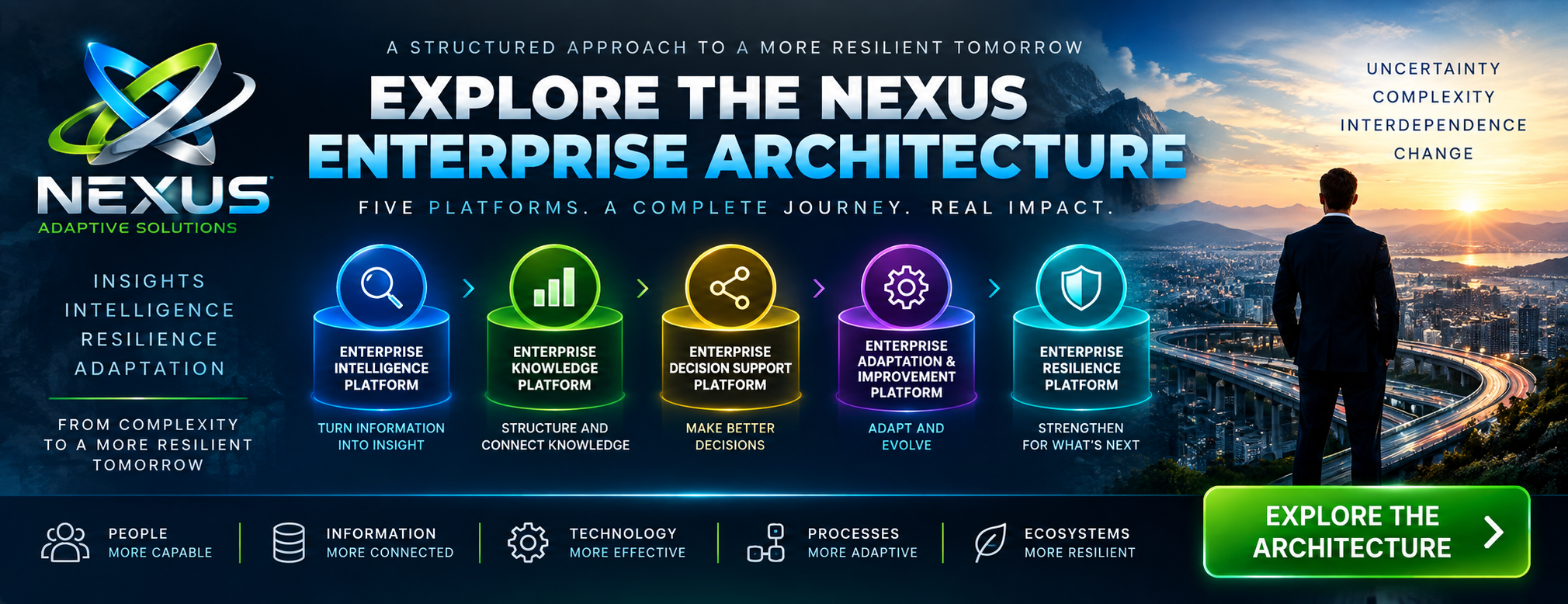
The next stage explores how organisations can respond through an integrated Enterprise Capability Architecture — connecting operational awareness, intelligence, decision support, adaptation and enterprise knowledge.
Explore the Enterprise Capability Architecture →Nexus Adaptive Solutions
Which Forces Matter Most to Your Organisation?
The operating environment contains more information and more potential sources of change than leadership can respond to individually.
The practical challenge is determining which developments are relevant to your organisation, how they relate to its operations and strategic objectives, and where they could create meaningful risk or opportunity.
The Intelligence Discovery Session provides a structured way to explore the challenges affecting your organisation, the decisions leadership needs to make and the capabilities that may be required.
The Enterprise Capability & Maturity Assessment provides a deeper evidence-based examination of existing enterprise capabilities, gaps and future requirements.