
Adaptive Operations · Episode 1 · Question 5
What Risks Emerge When Leaders Continue Managing as if Conditions Are Stable?
One of the most difficult organisational risks is not sudden failure. It is the possibility that an organisation continues operating successfully while becoming progressively less aligned with the environment in which it operates.
Operations may continue functioning. Projects may remain on schedule. Budgets may remain under control. Customers may continue buying. Employees may continue meeting their targets.
From inside the organisation, everything can appear to be working.
Yet the assumptions connecting those activities to the external environment may be weakening.
Customer expectations may have moved. Technology may have changed. Competitors may be developing different capabilities. Critical dependencies may be becoming less dependable. Workforce requirements may be changing. Regulatory or economic conditions may no longer resemble those assumed when current plans were created.
An organisation can execute successfully while becoming less aligned with its operating environment.
That is why execution performance alone cannot tell leadership whether the organisation's strategy remains appropriate.
From Question 4 to Question 5
What Happens When Assumptions Change but Management Does Not?
Question 4 examined why traditional planning assumptions can become less reliable when the conditions that produced historical patterns begin to change.
It introduced an important distinction between two questions:
Question 5 examines what can happen when the first question continues to receive attention but the second does not.
The organisation may become increasingly effective at executing a strategy developed for conditions that no longer fully exist.
Risk 1
Strategic Blindness
Strategic blindness can emerge when leadership continues interpreting new developments through assumptions created under previous conditions.
The organisation may still receive information about customers, markets, technology, suppliers, regulation and competitors.
The problem is not necessarily a lack of information.
It may be the way that information is interpreted.
Evidence that conflicts with existing assumptions can be treated as temporary, exceptional or unimportant.
A new competitor may initially appear too small to matter.
A change in customer behaviour may be interpreted as a short-term fluctuation.
A new technology may be viewed as immature.
Repeated operational exceptions may be treated individually rather than recognised as evidence of a changing pattern.
Existing assumptions influence which signals leadership considers important.
When those assumptions become outdated, important evidence can be visible without being recognised as strategically significant.
Risk 2
Slow Decision-Making
Decision processes are usually designed around an implicit expectation of how much time is available.
Information is gathered. Analysis is completed. Recommendations are prepared. Committees meet. Budgets are approved. Responsibilities are assigned.
In relatively stable conditions, these processes can provide valuable control and deliberation.
But if relevant conditions begin changing faster, the same process can create decision latency.
The important question is not whether the process is fast or slow in absolute terms.
It is whether it is fast enough for the conditions being managed.
If it is not, leadership can make a well-informed decision that arrives too late to preserve the original range of options.
Risk 3
Resource Allocation Becomes Misaligned
Strategy determines where organisations place scarce resources.
Capital is allocated.
People are recruited.
Technology is purchased.
Projects are prioritised.
Capabilities are developed.
These commitments are based on expectations about what the organisation will need.
If the environment changes but those expectations remain unchanged, resources can progressively become misaligned with future needs.
Investment can remain committed to priorities whose original assumptions have weakened.
Workforce plans can continue building capabilities that are becoming less relevant.
Technology investment can reinforce architectures designed for previous requirements.
Leadership time can remain concentrated on established priorities while emerging issues receive less attention.
Programmes can continue delivering outputs even as the environment around their original business cases changes.
The organisation can become stronger in areas that matter less while remaining weak in capabilities that are becoming more important.
An organisation can become highly effective at delivering priorities that are gradually becoming less relevant.
Risk 4
Reduced Organisational Agility
Organisations make commitments over time.
They build infrastructure, sign contracts, implement technologies, develop processes, establish governance structures and recruit people around particular ways of operating.
Those commitments provide stability and efficiency.
But they can also make changing direction more difficult.
If the operating environment remains broadly consistent with the assumptions behind those commitments, this may not be a problem.
If conditions change materially, the organisation may recognise what needs to happen but discover that it cannot adapt quickly.
Adaptability therefore depends on more than awareness.
The organisation also needs sufficient flexibility in its operating model, resources, technologies, dependencies and decision structures to act on what it knows.
The Execution Paradox
Strong Execution Can Reinforce the Wrong Assumptions
Organisations rightly value execution.
Leadership sets priorities and expects the organisation to deliver them.
Clear accountability, disciplined programme management and consistent performance are strengths.
But strong execution can create an unexpected problem when the assumptions supporting the strategy are changing.
Success against internal measures can reinforce confidence that the organisation remains on the right path.
A programme is green.
Milestones are achieved.
Budget is controlled.
Delivery targets are met.
Yet those measures primarily describe how effectively the organisation is executing its chosen course.
They may say much less about whether that course remains appropriate.
Early Signals
The Frontline Can See Change Before Leadership Does
Organisations often encounter environmental change first through frontline activity.
Sales teams hear different customer questions.
Customer-service teams see new categories of complaint.
Procurement teams notice changing supplier behaviour.
Operations teams see recurring exceptions.
Engineers identify emerging technical constraints.
Technology teams see changing usage or performance patterns.
Risk teams observe emerging exposures.
Individually, these observations may appear operational rather than strategic.
But collectively they may provide early evidence that an assumption about the environment is weakening.
Information existing somewhere inside the organisation is not the same as that information influencing an executive decision.
The organisation needs mechanisms that allow important signals to move from the point where they are first observed to the point where their wider significance can be assessed.
Organisational Alignment
When Operational Reality and Leadership Assumptions Diverge
A gap can gradually emerge between what frontline teams experience and what leadership believes about the organisation's environment.
Frontline teams may begin adapting informally.
They create workarounds.
They change how they deal with customers.
They compensate for unreliable suppliers.
They manually resolve exceptions that established processes do not handle well.
In the short term, this can protect organisational performance.
But it can also hide evidence that the operating model is becoming less aligned with reality.
Ironically, effective frontline adaptation can sometimes delay leadership recognition of a structural problem because employees successfully absorb the consequences.
Gradual Organisational Decline
Decline Does Not Always Begin with a Crisis
Organisations can become less competitive or less relevant gradually.
There may be no single event that clearly demonstrates that the strategy has stopped working.
Instead, small changes accumulate.
- Customers begin moving towards alternatives.
- Competitors gradually gain ground.
- Existing capabilities become less differentiated.
- Investments continue supporting older priorities.
- New opportunities are recognised later than they could be.
- Responses occur after other organisations have already moved.
- Operational workarounds become increasingly common.
- Resources remain committed to assumptions formed under previous conditions.
The organisation may still possess a strong brand, talented people, established customers, valuable assets and healthy revenues.
Those strengths can provide resilience.
But they can also make gradual misalignment less visible.
Leading and Lagging Evidence
Headline Performance May Tell Leadership Too Late
Many of the measures leadership naturally monitors are lagging indicators.
Revenue, profitability, customer loss, service performance and project outcomes often describe consequences after underlying conditions have already changed.
By the time deterioration becomes visible in those measures, some of the organisation's options may already have narrowed.
Earlier indicators may exist elsewhere.
Changing questions, expectations, behaviours or reasons for choosing alternatives.
Longer lead times, changing terms, recurring failures or increasing concentration.
More exceptions, workarounds, manual intervention or repeated escalation.
New capabilities, changing architectures or declining suitability of existing systems.
Increasing difficulty accessing skills or changing capability requirements.
New propositions, business models, capabilities or entrants changing customer expectations.
The leadership challenge is to connect these earlier signals to the assumptions and decisions they may affect.
Strategic Consistency
Adaptability Does Not Require Strategic Instability
Recognising that assumptions can change does not mean that organisations should continually change strategy.
Constantly changing direction would create instability of its own.
Organisations need continuity.
Employees need clear priorities.
Investments need time to deliver.
Capabilities need time to develop.
The important distinction is between the elements of the organisation that should remain relatively stable and those that may need to adapt.
An organisation can be strategically consistent without being strategically rigid.
Adaptive Capability
Recognising Change Is Only the Beginning
Awareness of a changing environment is valuable, but awareness alone does not make an organisation adaptive.
The organisation needs to move from observing change to understanding what it means and deciding what to do.
Can relevant developments in the operating environment be recognised?
Can significant signals be distinguished from background noise?
Can external developments be connected to organisational objectives, operations and dependencies?
Can leadership understand where the organisation may be affected and how significant that effect could be?
Can evidence be translated into useful choices for decision-makers?
Can the organisation actually change resources, operations, capabilities or priorities when required?
These are different capabilities.
An organisation may be excellent at monitoring the environment but poor at connecting external developments to internal exposure.
It may understand its exposure but have slow decision processes.
It may make good decisions but lack the flexibility required to execute them.
Adaptive operations therefore requires the complete journey from knowledge to understanding to decision to adaptation.
The Key Takeaway
The Greatest Risk May Be Misalignment Without Immediate Failure
When leaders continue managing as though conditions are stable, the organisation does not necessarily fail immediately.
That is what makes the problem difficult.
Established capabilities can continue delivering.
Existing customers can continue buying.
Teams can continue achieving their targets.
Programmes can continue progressing.
But if the environment is moving while organisational assumptions remain fixed, alignment can gradually deteriorate.
The organisation can become increasingly effective at executing a strategy designed for an environment that is progressively disappearing.
The objective of adaptive operations is not to create continuous organisational change.
It is to recognise when material change has occurred, understand what it means and adapt when the evidence demonstrates that adaptation is necessary.
Executive Reflection
Questions for Leaders to Consider
Strategic Alignment
- Which assumptions about the operating environment underpin your current strategy?
- How recently were those assumptions explicitly reconsidered?
- What evidence would demonstrate that one of them was no longer valid?
Decision-Making
- How long does it take for an important environmental signal to reach the people capable of acting on it?
- How long does the organisation take to determine whether a response is required?
- Could an appropriate decision arrive after the most valuable opportunity to act had already passed?
Frontline Intelligence
- Where would the earliest evidence of changing customer, supplier or operational conditions appear?
- Are frontline observations connected across functions?
- Can recurring operational workarounds become visible as evidence of a wider structural issue?
Resource Alignment
- Are current investment priorities still aligned with the organisation's emerging requirements?
- Which major commitments would be difficult to reverse?
- Could resources be redirected if a strategic assumption changed?
Organisational Adaptability
- What can the organisation change quickly?
- What would take months or years to change?
- Are those adaptation times appropriate for the speed at which the relevant parts of the environment can change?
The Final Episode 1 Question
Completing the Question Bank
Connecting the Five Episode 1 Questions
Question 5 completes the progression developed across the Episode 1 Question Bank.
What does it mean to say that stable operating environments are disappearing?
What technological, economic, customer, regulatory, workforce, environmental and information forces are contributing to that change?
How are organisations experiencing changing markets, dependencies, competition, technology and faster feedback loops?
What happens to forecasting and planning when the conditions supporting historical patterns become less dependable?
What happens when organisational assumptions and decisions fail to keep pace with the environment?
What capabilities does an organisation need to recognise, understand and respond to material change?
The five questions move from understanding the external environment to understanding the organisational capability required to operate within it.
Key Takeaways
What Risks Emerge When Stable Assumptions Persist?
- Strategic blindness can occur when new evidence continues to be interpreted through outdated assumptions.
- Decision processes that worked in slower environments can create damaging latency when relevant conditions accelerate.
- Resources can remain committed to priorities whose underlying assumptions have weakened.
- Existing commitments can make adaptation difficult even after leadership recognises that change is required.
- Strong execution can reinforce confidence in a strategy whose continued relevance has not been reconsidered.
- Frontline teams may see environmental change before senior leadership does.
- Effective operational workarounds can temporarily hide structural misalignment.
- Organisational decline can develop gradually rather than through one obvious crisis.
- Headline financial and operational measures may reveal misalignment only after earlier signals have been available for some time.
- Adaptability means maintaining strategic consistency without becoming strategically rigid.
The Episode 1 Journey
You’ve Reached the Final Episode 1 Question Bank
Question 5 completes the five-question sequence.
You can return to Question 4 to revisit the relationship between planning and changing assumptions, or continue into the full Episode 1 discussion where the five questions are brought together within the wider Adaptive Operations narrative.
Continue Exploring
Explore the Episode 1 Question Banks
Return to any part of the five-question journey to explore the individual topics in more detail.
Episode 1 · Full Discussion
Explore the Complete Episode
The End of Stable Operating Environments brings all five Question Banks together into the complete Episode 1 discussion.
The full episode follows the complete progression from understanding declining environmental stability and the forces driving it, through greater volatility and changing planning assumptions, to the implications for leadership, decision-making and organisational adaptation.
The Next Stage of Episode 1 (Part 1)
From Operational Uncertainty to Enterprise Resilience
Across the five Question Banks, we have explored what happens when organisations can no longer assume that their operating environment will remain sufficiently stable.
The next question is therefore practical: what capabilities does an organisation need to understand changing conditions, make better decisions and continuously adapt?
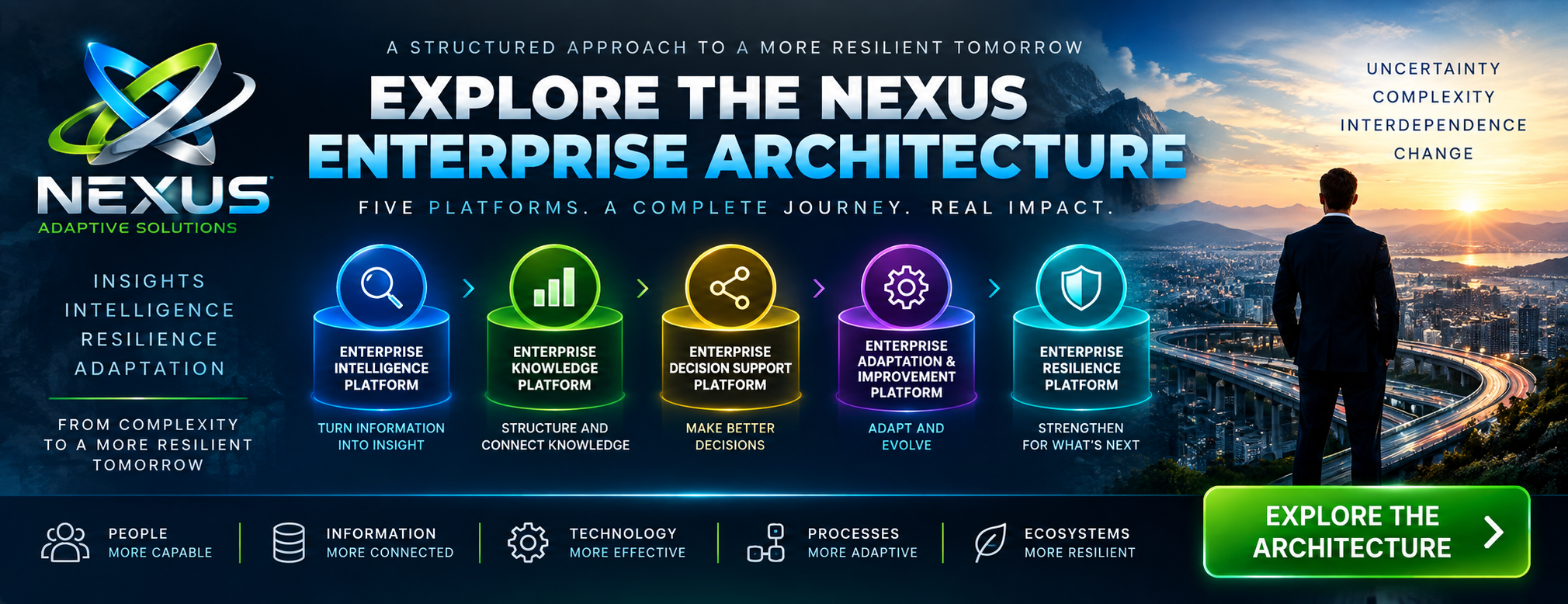
From Operational Uncertainty to Enterprise Resilience introduces the Enterprise Capability Architecture, its five Enterprise Platforms and the first 14 capability groups within the Operating Environment Dynamics Enterprise Domain.
Continue to the Enterprise Capability Architecture →Nexus Adaptive Solutions
How Adaptive Is Your Organisation Today?
Episode 1 establishes the environmental challenge. The next question for leadership is how well the organisation is equipped to operate within that environment.
Can it identify relevant external change? Can it understand how that change relates to its operations and objectives? Can it assess exposure, support decisions and adapt when the evidence demonstrates that change is required?
The Intelligence Discovery Session provides a structured way to explore your organisation's challenges, the decisions leadership needs to make and the enterprise capabilities that may be required.
The Enterprise Capability & Maturity Assessment provides a deeper evidence-based examination of existing capabilities, constraints, gaps and future requirements.